
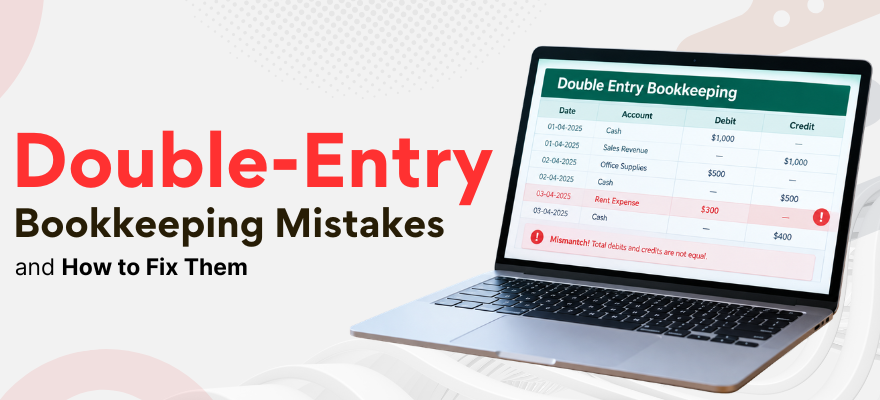



Double-entry bookkeeping is built to catch errors. And it does, some of the time. But it's not a safety net that catches everything. A transaction can land in the wrong account entirely, and the books will still balance to the last decimal. Nothing looks broken. Everything adds up. The numbers are just quietly wrong.
Some bookkeeping errors show up immediately, the moment your debit and credit sides stop matching. You'll catch those on your own, usually the same day. Others sit in your accounting records for weeks or months, undetected, until a tax filing, an audit, or a confused client finally forces someone to go looking.
This article walks through 10 of the most frequent double-entry bookkeeping mistakes, why each one happens in practice, and what actually corrects it once it's found.
What Is Double-Entry Bookkeeping?
A short recap before the mistakes, since the real focus here is what goes wrong, not the mechanics of the system itself.
In double-entry bookkeeping, every financial transaction touches at least two accounts at once. One account is debited, the other is credited, and the two sides must always be equal in value. This dual recording is what gives the system its name, and it's also what makes it self-checking, at least for certain kinds of errors.
Take a simple case: a business buys equipment and pays with cash. The Equipment account goes up, so it's debited. The Cash account goes down, so it's credited. One transaction, two accounts, one balanced entry.
That part is straightforward. The trouble starts once real people, real invoices, and real time pressure enter the picture.
If you want to build a solid foundation in how debit and credit rules work before tackling the mistakes below, our WSQ Essentials of Double-Entry Bookkeeping Course breaks the entire system down step by step.
10 Common Double-Entry Bookkeeping Mistakes
Each mistake here follows a consistent shape: what the error looks like, a working example, why it tends to happen, how to correct it, and how to stop it from repeating.
1. Reversing Debit and Credit Entries
This mistake happens when the bookkeeper picks the correct accounts but flips which side gets debited and which gets credited.
A correct entry for an office expense paid in cash looks like this:
Debit: Office Expense Credit: Cash
Reversed, it looks like this instead:
Debit: Cash Credit: Office Expense
The accounts are right. The direction is backwards. This usually comes from working too fast, or from someone still learning which account types increase with a debit and which increase with a credit. Expense and asset accounts behave differently from liability and revenue accounts, and mixing that rule up is one of the easiest slips to make early on.
Fixing it means pulling the original document, confirming the correct treatment, and re-entering the transaction the right way round. Preventing it comes down to slowing down on any account type that isn't second nature yet and double-checking before the entry gets posted.
2. Recording the Wrong Amount
An invoice reads $1,250. The ledger accounts show $1,520. Two digits got swapped somewhere between the paper and the entry, and now both sides of the transaction are wrong by the same amount.
This is almost always a manual typing slip. It happens when someone reads a number quickly, copies from a handwritten note, or transposes digits without noticing.
Fixing it starts with going back to the source document and confirming the real figure, then correcting both the debit and credit sides to match. Preventing it means cross-checking every manually entered amount against its invoice or receipt before the entry is finalised, especially for larger transactions where the impact of an error is bigger.
3. Omitting One Side of a Transaction
Here, only half the transaction gets recorded. The debit goes in; the credit doesn't. Or the credit goes in, and the debit gets left out entirely. Either way, the entry is incomplete, and the books stop balancing.
This tends to happen during busy stretches or when someone gets interrupted mid-entry and never circles back to finish it properly.
Fixing it usually starts with reviewing the trial balance. An imbalance is often the first sign something's missing. Once the gap is found, the missing side gets added to complete the entry. Preventing it is mostly about discipline: finish one transaction fully before moving to the next one, rather than batching half-done entries.
4. Posting a Transaction to the Wrong Account
This is one of the harder mistakes to catch, because it doesn't disturb the balance at all.
Say a business buys a computer, and it gets recorded as an office expense instead of Equipment. Office Expense is debited, Cash is still credited, and the entry balances perfectly. But the classification is wrong, which means the financial transactions feeding into your reports are misrepresented, even though the arithmetic checks out.
This usually stems from an unclear chart of accounts or from someone guessing at the right category instead of checking it.
Fixing it requires a correcting journal entry that shifts the amount from the wrong account into the right one. Preventing it means keeping the chart of accounts simple and well-defined and making sure anyone entering transactions actually understands what belongs where.
If misclassification is a recurring problem in your bookkeeping system, it's worth revisiting how your account structure is set up. Our WSQ Bookkeeping and Financial Records Management Course covers this area in more depth.
5. Recording the Same Transaction Twice
A duplicate invoice gets entered. Or a bank transaction that was already imported automatically gets typed in manually as well. Same payment, counted twice, inflating either expenses or revenue depending on which side it falls on.
Each individual entry can look perfectly correct on its own. The problem only shows up once you compare totals against reality.
Bank reconciliation is usually what surfaces this kind of error, since duplicates create a mismatch between the books and the bank statement that's hard to explain any other way. Fixing it means reversing the extra entry once it's identified. Preventing it means being careful with manual entries whenever transactions are already syncing through accounting software.
6. Creating Incorrect Journal Entries
This one is broader, covering a cluster of related slip-ups: a wrong account, a wrong date, a wrong amount, or an incorrect debit-and-credit treatment, sometimes more than one at the same time.
Journal entries created under time pressure, or without checking the underlying source document first, are where most of these errors come from.
Fixing it means addressing each error individually with a correcting entry once it's spotted. Preventing it comes down to reviewing journal entries before they're posted, particularly anything unusual, one-off, or outside the normal routine.
7. Incorrectly Recording Accounts Receivable or Accounts Payable
These two work in opposite directions, and mistakes tend to cluster around the same points in each.
Accounts receivable: a customer buys on credit. The invoice gets recorded. The customer pays later, and that payment clears the balance. Miss a step anywhere in that sequence, and the amount owed on the books no longer matches reality.
Accounts payable: the business receives a supplier invoice, records the liability, and pays the supplier afterward. Same structure, reversed direction.
The most common slips here are forgetting to record the invoice at all, recording a payment without clearing the original invoice against it, or applying a payment to the wrong customer or supplier account entirely.
Fixing it means matching invoices against payments and correcting whatever doesn't line up. Preventing it means reconciling receivables and payables on a regular basis, rather than letting them build up until something forces a review.
8. Failing to Record Accrued or Outstanding Expenses
Electricity gets used in December. The invoice doesn't arrive until January. If the expense isn't recorded for December, that month's numbers understate what the business genuinely spent, simply because the paperwork hadn't caught up yet.
This gets missed because the cost hasn't been billed, and unbilled costs are easy to forget when nothing's landed in the inbox.
Fixing it means posting an accrual entry that records the expense in the period it actually belongs to, even ahead of the invoice arriving. Preventing it means reviewing recurring costs at the end of each month and asking what's been used but not yet billed.
Accrued expenses like this one come up constantly in real bookkeeping work. Our Fundamentals of Bookkeeping and Accounting Course covers accrual concepts in more depth; if this is an area your team could use a refresher on.
9. Recording Depreciation Incorrectly
Depreciation mistakes show up in a few different forms: it gets forgotten entirely, the amount is calculated wrong, it's posted in the wrong period, or it lands in the wrong account.
Take a simple fixed-asset example. A business buys a machine for $10,000 with a five-year useful life. If depreciation isn't recorded, that machine stays on the books at its full original value long after it's actually lost value, and the period's expenses end up understated as a result.
Fixing it means recalculating the correct depreciation figure and posting a correcting entry to bring the account back in line. Preventing it means setting a fixed review schedule, monthly or quarterly, so depreciation doesn't quietly slip through unrecorded.
10. Not Reconciling the Books With Bank Records
Your bookkeeping system and your bank statement should always tell the same story. In practice, they often don't, and the gap is where a lot of hidden mistakes live.
Common causes include missing transactions, duplicate entries, bank charges that never got recorded, incorrect amounts, and payments that were issued but haven't cleared the bank yet.
Fixing it means comparing the books line by line against the bank statement and adjusting for whatever's missing, duplicated, or mismatched. Preventing it means treating bank reconciliation as a routine, scheduled task, not something squeezed in once a year when someone finally has the time.
Can Double-Entry Bookkeeping Prevent Every Accounting Error?
No. Double-entry bookkeeping can help catch certain kinds of accounting errors, but it doesn't guarantee that every mistake will surface.
Here's the clearest way to see why. Take this correctly recorded entry:
Debit Equipment $2,000 Credit Cash $2,000
Now compare it against this one:
Debit Office Expense $2,000 Credit Cash $2,000
Both entries balance without issue. Both look correct at a glance. But the second one is wrong, because the classification doesn't reflect what actually happened. Double-entry bookkeeping checks that debits equal credits. It has no way of checking whether the right account was chosen in the first place.
That's precisely why manual review and regular reconciliation still matter, even inside a system that's designed to self-check.
How to Fix Double-Entry Bookkeeping Errors
A practical, step-by-step process for correcting bookkeeping errors once they're found:
- Identify the incorrect transaction. Usually flagged by an imbalance, a reconciliation mismatch, or a figure that just looks off against expectations.
- Check the original source document. The invoice, receipt, or bank statement that backs up the transaction.
- Identify the correct accounts. Confirm exactly where the transaction should have been posted.
- Check the debit and credit amounts. Make sure the figures match the source document precisely.
- Make the correcting journal entry. Reverse the incorrect entry if needed, then post the correct one in its place.
- Reconcile the affected account. Confirm the balance now reflects what actually happened.
- Check the financial statements again. Make sure the correction has flowed through properly to every affected report.
How to Prevent Common Bookkeeping Mistakes
A short, practical checklist worth building into a regular routine:
- Keep supporting documents for every transaction, without exception.
- Use consistent account classifications across the entire bookkeeping system.
- Review journal entries before they're posted, not after
- Reconcile bank accounts on a fixed schedule, not whenever there's spare time.
- Check accounts receivable and accounts payable balances periodically
- Review any balance that looks unusual or unexpected
- Watch closely for duplicate entries, especially where bank feeds sync automatically
- Use accounting software carefully, not as a substitute for judgement
- Build in periodic reviews of the accounting records, even when nothing seems wrong on the surface
Want to build a stronger foundation in bookkeeping accuracy? Our LCCI Level 1 Bookkeeping Course covers the core skills needed to understand and record everyday bookkeeping transactions accurately.
 +65 8421 2824


 Chat With Us